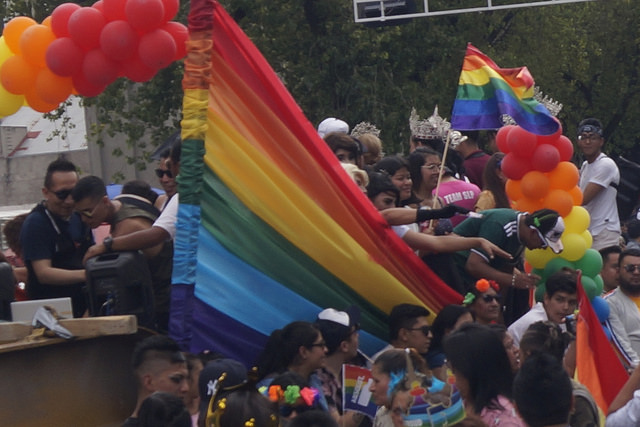
Just before the world celebrates Gay Pride Month, Chile passed a law that allows transgender citizens to change their name and sex on state registries without needing a sex-change operation. At the same time, Ecuador recognizes a lesbian couple’s legal right to adopt a child. People celebrate after the Inter-American Court of Human Rights called on Costa Rica to recognize equal marriage. These and other monumental LGBTQI legal precedents in Latin America over the past decade are recalling the queer and transgender revolutionaries who began the History of LGBT Movement in Latin America more than 50 years ago.
🏛️ HISTORY IN THE MAKING (Updated Jan 19, 2026)
Since this history was first recorded, Mexico has emerged as a global leader in LGBTQ+ rights—leading to a massive surge in international retirement. To see how this history has paved the way for your future in PV, check out our 2026 Moving & Retirement Guide.
Social Movements
Argentina was at the forefront of gay pride in Latin America. Gays in Argentina created Nuestro Mundo (‘Our World’) in 1967, considered South America’s first public homosexual organization. In 1971, the Homosexual Liberation Front formed and two years later they started to publish the region’s first gay magazine: Somos (‘We Are’).
But Argentine society experienced a whiplash against human rights, including those of gays and trans people, of every sort during the military government’s Dirty War between 1976 and 1983, disappearing or killing up to 30,000 people. Their ‘cleaning campaign’ targeted gays in order to ‘scare homosexuals from the streets to not bother decent people.’
Though Brazil was living through its own dictatorship from 1964 to 1985, the gay community there – and society in general – was experiencing a shift toward democracy by the late 1970s. Lampião (‘The Lamp’) gay newspaper began publishing in 1978 to become the ‘primary communication vehicle for the homosexual community.’
A year later, São Paulo homosexuals formed the first openly gay organization, Somos, which was followed by a flurry of new gay and lesbian groups in Rio de Janeiro, Salvador, Curitiba and the Amazon. The Feminist-Lesbian Action Group staged what’s considered Brazil’s ‘Stonewall’ at Ferro’s Bar in São Paulo, in 1983.
Gay Activists
Gay activists managed to organize in Chile, even under the Augusto Pinochet (1973-1990) dictatorship. Integracion (‘Integration’) was the country’s first gay group, founded in 1977.
The country’s first lesbian organization – Feminist Lesbian Collective Ayuquelen, founded in 1984 – was important to homosexual and feminist rights and didn’t seek to assimilate into conservative society like its predecessors. The group of women who led it were revolutionary because they formed after the highly conservative and patriarchal 1980 constitution made ‘illegal’ any transgressions against the state, family and the Catholic church.
Ayuquelen became a critical but small organization that worked to not only advance lesbian and gender rights but also helped return democracy to the country.
Like its South American neighbors, Mexico began to experience its own wave of gay rights movements in the 1970s. The Homosexual Liberation Front was Mexico’s first gay organization, forming in 1971.
Nancy Cardenas became the first person in Mexico to publicly declare her homosexuality in 1973 and led Mexico’s Gay Liberation Front (GLF). By 1978, several other LGBTQ rights organizations had formed that not only advocated for freedom of sexual expression in Mexico but the Cuban and Nicaraguan revolutions.
Gay Pride
It was also in the 1980s and 90s that HIV and AIDS began to shake the Americas. The burden fell heaviest on the already socially discriminated gay, lesbian and trans communities.
Across Latin America, the Catholic church, so embedded in the region’s social ethos, claimed the disease was a “divine intervention” to punish their gender and/or sexual orientation. Rights organizations had to not only fight discrimination but also the stigma of the disease that was so inaccurately linked to the gay and lesbian community.
Despite, or perhaps in part of this health epidemic, the ’90s also became a decade when more people publicly began to express their gender and sexual identity.
The annual Festival Mix Brazil of Cinema and Video of Sexual Diversity was launched in 1993. Rio de Janeiro – widely considered one of Latin America’s most LGBTQI-friendly neighborhoods – held Brazil’s first Gay Pride parade in 1995, followed by Sao Paulo in 1997.
During this decade, trans communities also became more visible. The ILGA (International Lesbian and Gay Association), formed in 1978, became Ilgalac: the International Lesbian, Gay, Bisexual, Trans and Intersex Association for Latin America and the Caribbean.
As the LGBTQI community gained public space, they also gained political ground.
Argentina, always at the forefront of gay and trans rights, became the first country in Latin America to legalize gay marriage in 2010 after several of its cities allowed same-sex civil unions during the decade leading up to the national decision. Mexico City legalized gay marriage that same year, and it was approved across the country by 2017.
In 2013 homosexual marriage was legalized in Uruguay under the progressive government of Pepe Mujica, and in Brazil under Dilma Rousseff. By that time Brazil had already become the first Latin American country to legalize adoption for same-sex partners, doing so in 2010.
Fighting Chilean conservatism, former President Michelle Bachelet pushed hard to legalize gay marriage in 2017, just months before she left office.
Unfortunately, Central American countries have either no laws to provide equal rights to gays and trans, or have punitive laws against them. Honduras banned same-sex marriage and gay adoptions in 2005 and El Salvador is working on similar legislation.
Costa Rica finally legalized gay marriage and transgender rights this year, but only after the Inter-American Court of Human Rights ordered it to do so.
The Legacy of the Movement: Puerto Vallarta in 2026
The history of the LGBTQ+ movement in Latin America isn’t just a collection of dates; it is the foundation of the safety and freedom we enjoy in Puerto Vallarta today. From the early activism of pioneers like Nancy Cárdenas to the 2022 nationwide legalization of same-sex marriage in Mexico, every milestone has paved the way for PV to become a global sanctuary.
In 2026, we are seeing the direct results of this long struggle. Puerto Vallarta has evolved from a “secret getaway” into a Top Global LGBTQ+ Retirement Hub. Today’s expats aren’t just looking for a vacation; they are looking to join a community that has spent decades fighting for—and winning—its seat at the table.
✨ Make History Your Future
Are you ready to stop visiting history and start living it? Our 2026 Moving to Mexico Master Guide is the most updated resource for LGBTQ+ expats, covering the new 2026 residency income requirements, the “Versalles Pivot,” and the essential Resident Shield for healthcare.
For a deeper look at how the local community continues to thrive, visit our LGBTQ+ Expat Guide to Living in PV.
Read the Full Source Article www.telesurtv.net

Author: Tim Wilson
Wilson is the founder of GAYPV.com and www.gaybartour.com and has been the leading LGBTQ+ travel and lifestyle authority in Puerto Vallarta since 2005. With over two decades of local expertise, Wilson specializes in being a community advocate and leader for Puerto Vallarta , and local cultural insights that only a long-term resident can provide. He has dedicated 20+ years to advocating for safe, inclusive travel in Banderas Bay, establishing GAYPV as the region's most trusted resident insider.. His work has been cited by major travel publications, and he is widely recognized as a trusted insider voice on Puerto Vallarta’s vibrant LGBTQ+ scene.